Criminal defence in Scarborough
Criminal defence lawyer in ScarboroughStart with the paper police gave you
Arrested, or holding a police paper with a court date? That paper says where you must be and what you must not do. Below: each kind of paper, bail, the steps of a case, and what a plea can do to your status in Canada.
Call Muhammad Nadeem: (289) 937-1998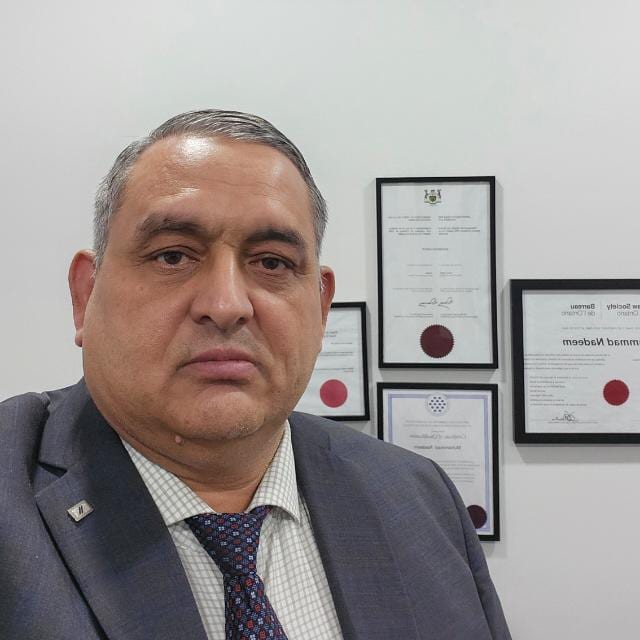
Which paper is in your hand?
The paper decides your next move, so find yours in this table. It follows the Ontario Court of Justice step-by-step guide. Some papers also give a time and place for fingerprints and a photograph, and that date counts too.
| The paper | How you got it | What it asks of you | If you do not follow it |
|---|---|---|---|
| Summons | Police gave it to you to tell you that you are charged. You may never have been arrested. | Be at court on the date, time and place printed on it. | A warrant can be issued for your arrest, and you can face a new charge of failing to attend. |
| Appearance notice | You were arrested, then released by police. | The same: court at a set time and place, with no conditions on your daily life. | The same warrant and the same new charge. |
| Undertaking | You were arrested, then released by police on conditions. | Attend court and obey each condition, for example staying in one area or not speaking to certain people. | Arrest, custody and a new charge of failing to comply. |
| Release order | A judge or a justice of the peace released you after a bail hearing. | Attend court and obey the order's conditions. A surety may be named in it. | Your surety may have to pay the amount in the order, on top of what happens to you. |
When police keep someone in custody
There is no paper yet. The person normally stays at a police station until a judge or a justice of the peace can hear the bail case. Ontario has weekend and holiday bail courts for this. Section 11(e) of the Charter protects the right to reasonable bail.
At the hearing the Crown (the prosecutor) either agrees to a release with conditions or tries to prove the person should stay in jail. The person has their own lawyer or duty counsel, a free lawyer who works in bail court every day.
Families are often asked to act as a surety: a friend or relative who answers for the accused until the case ends. Anyone ready to do this should contact the lawyer or duty counsel. A surety:
- makes sure the person comes to court and obeys the conditions;
- promises to pay money, or in exceptional cases deposits it;
- may have to pay if the person breaks a term, misses court or gets a new charge;
- can go to the courthouse at any time and ask to be relieved of the duty.
A Scarborough charge may not be heard in Scarborough
Many people expect to go to 1911 Eglinton Avenue East. Yet the court's notice of April 2023 moved the adult case management courtroom from that building downtown. Go by the place printed on your own paper, and read each new paper again.
Zoom or in person
Case management dates, if you are out of custody, unless the court directs you to attend.
By video
Judicial pre-trials, the meeting with a judge, unless the court says otherwise.
In person
A guilty plea, a preliminary inquiry or a trial, unless the court allows otherwise. See the court's practice direction.
The road from your first date in court
The first date is rarely the day anything is decided. Most of the work happens on the way, and your lawyer's first job is to read what the Crown has.
Muhammad Nadeem takes people through these stages as part of his criminal defence work.
Case management court
Your first appearance, often before a justice of the peace. The talk is about disclosure, whether you have a lawyer, and the next meeting. No guilty pleas and no trials happen here.
Disclosure
The Crown must give you everything it has on your case unless it is clearly irrelevant or privileged. That can mean the list of charges, officers' notes, video and witness statements. You usually get it before or at the first appearance, and more can follow.
Crown pre-trial
Your lawyer and the Crown discuss the evidence, the Crown's position on sentence, and whether the case goes to trial. Be careful what you say to the Crown on your own.
Judicial pre-trial
A judge, the Crown and your lawyer sort out the issues. A date is then usually set for a plea, a preliminary inquiry or a trial, unless the case has been resolved.
Four ways a case can end
Withdrawal
The Crown drops the charge when it finds no reasonable prospect of conviction or no public interest in going on.
Diversion
If offered, you do set work such as counselling or community service. The Crown then withdraws or stays the charge. A stayed charge can come back within one year.
Guilty plea
You give up your right to a trial. The judge must be satisfied that you understand the consequences, and is not bound by a deal on sentence.
Trial
The Crown must prove every essential element beyond a reasonable doubt. If not, you are found not guilty and free to go.
If you are not a Canadian citizen, read this before any plea
A result that looks small in criminal court can be large under the immigration law. It turns on your conviction and your sentence, and on the longest sentence the law allows for the offence.
Permanent residents
Section 36(1)(a) of the Immigration and Refugee Protection Act makes you inadmissible for a conviction in Canada when the offence carries a maximum of 10 years or more, or when you get more than six months in prison. Inadmissible means Canada can move to remove you.
Under section 64, a sentence of six months or more also closes the appeal to the Immigration Appeal Division.
Visitors, students, workers and other foreign nationals
Under section 36(2)(a), one conviction for an offence that can be prosecuted by indictment is enough, or two offences from separate events.
Section 36(3)(a) goes further. Many offences can be prosecuted two ways, and they count as indictable even when the Crown chose the lesser way. A final acquittal cannot be the basis for any of this.
Tell your lawyer your exact status, and show your card or permit, before you agree to anything.
Status questions run alongside the criminal case, and the office also handles immigration matters. A conviction can also touch a family's sponsorship plans: our article on what a refused spousal sponsorship leaves you explains the appeal routes.
What people ask after a charge
- Police let me go with a paper, and I did nothing wrong. Do I still have to go to court?
- Yes. The paper is an order to attend. Going to court is not an admission: under the Charter you are presumed innocent until proven guilty. Staying away can bring an arrest warrant and a new charge.
- Can a lawyer go to court for me?
- In case management court, yes. The court's guide says your lawyer may attend on your behalf, attend with you, or send you with information for the court. A guilty plea or a trial needs you there, unless the court allows otherwise.
- Should I plead guilty on my first day in court?
- It cannot happen in that courtroom: case management court holds no guilty pleas and no trials. Before you decide on a plea, the court itself strongly encourages you to get legal advice.
- My bail conditions stop me from going home. Can they change?
- They can. If the Crown agrees, the change is made on consent. If the Crown says no, you can apply to the court. Until then the conditions stand, and breaking one can put you back in custody.
- My English is not strong. Can I have an interpreter?
- Section 14 of the Charter gives a person in court who does not understand or speak the language the right to an interpreter. The court's guide has a section on interpreters, so raise it before your court date.
Sources: Ontario Court of Justice, Criminal Court step by step, practice direction on mode of appearance, and Toronto case management courts notice of April 26, 2023; Canadian Charter of Rights and Freedoms, sections 10, 11 and 14; Immigration and Refugee Protection Act, sections 36 and 64.
Bring the papers to 1225 Kennedy Road
Muhammad Nadeem is a Barrister and Solicitor licensed by the Law Society of Ontario, and you can read more about him here. The first 30 minutes are free. You can explain what happened in English, Urdu, Punjabi or Hindi.
For that first meeting, bring:
- every paper from the police or the court, with its next date
- the police occurrence number, which is on your release papers
- any disclosure you have already received
- your passport, permanent resident card, or study or work permit
You have the right to retain a lawyer without delay when you are arrested or detained, and to be told about that right (Charter, section 10(b)). The office is open Monday to Friday, 10:00 to 6:00, and Saturday by appointment.

Book a consultation at 1225 Kennedy Road, Scarborough.
Contact the office